

Summary
Graph representations of relational data have become a cornerstone of modern data science and machine learning, enabling insights across domains from biology and neuroscience to social science and engineering. Techniques from graph mining and learning allow us to detect functional modules in biological networks, identify communities in social systems, infer missing links, and tackle node-, edge-, and graph-level classification problems.
This course introduces students to the foundations and state-of-the-art methods for supervised and unsupervised learning on complex networks. Topics include statistical learning for clustering and link prediction, low-dimensional embeddings of graph-structured data, and deep learning approaches such as graph neural networks (GNNs). Students will gain hands-on experience applying these techniques to real-world datasets and learn how to translate theoretical insights into practice.
Lectures
Chapter I: Foundations of Graph Learning
The first chapter of our course motivates the growing need for machine learning techniques for graph-shaped data in science, industry, and society. We introduce graph-theoretic and algorithmic foundations of network analysis and introduce probabilistic generative models that are the basis for statistical learning in networks.
- Motivation
- Graph-Theoretic Foundations
- Generative Models and Inference
Chapter II: Cluster Detection & Link Prediction
The second chapter of our course introduces techniques to detect cluster structures in networks. We show how we can use description length minimization and flow compression to find optimal parsimonious cluster structures. We further introduce the link prediction and discuss statistical, topological, and heuristic methods to address it.
- Stochastic Block Model
- Entropy and Description Length
- Random Walks and InfoMap
- Node Similarities & Link Prediction
Chapter III: Graph Representation Learning
The third chapter introduced techniques to learn low-dimensional vector space representations of networks, that can be used to address downstream graph learning tasks. We introduce matrix decomposition techniques for representation learning and show how neural networks and random walks can be used to position nodes in a vector space.
- Graph Representation Learning
- Supervised Graph Learning
- Neural Representation Learning
Chapter IV: Graph Neural Networks
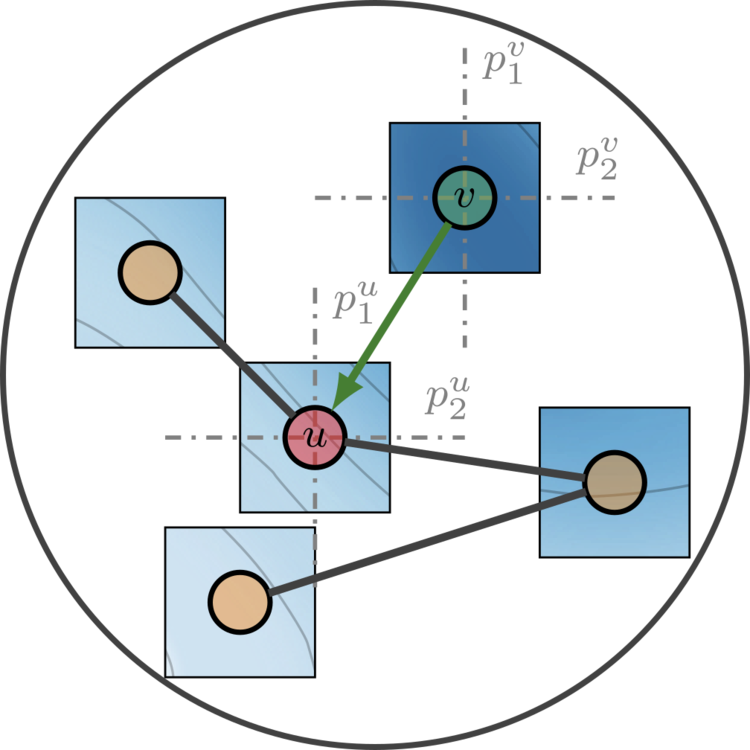
In the final chapter, we show how deep learning techniques can be applied to graph-structured data. We introduce the concept of message passing and discuss how the graph Laplacian can be used to define graph convolutional networks. We introduce graph neural networks for node-, link-, and graph-level learning tasks.
- Graph Neural Networks
- Graph Kernels