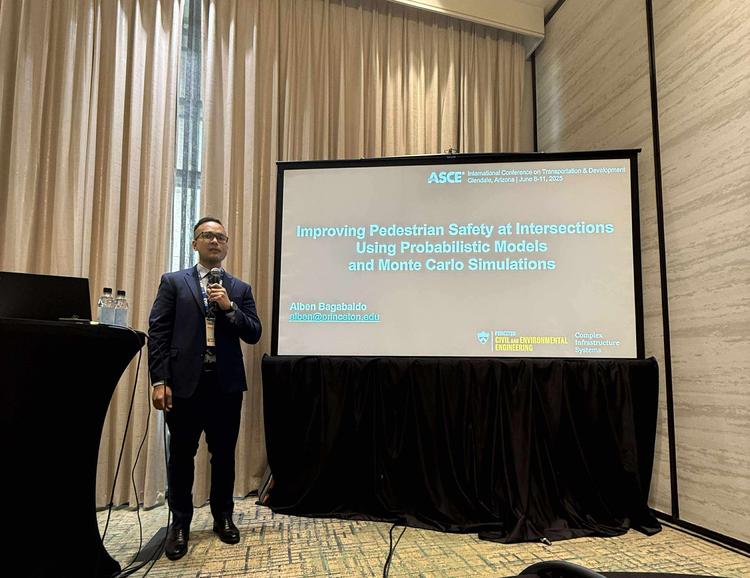
During the American Society of Civil Engineers (ASCE) International Conference on Transportation & Development (ICTD) 2025, held in Glendale, Arizona from June 8 to 11, Complex Infrastructure Systems (CIS) postdoc Alben Bagabaldo presented our recent work, “Improving Pedestrian Safety at Intersections Using Probabilistic Models and Monte Carlo Simulations.” Drawing on cutting-edge probabilistic modeling, our research provides a nuanced understanding of pedestrian crossing behavior by integrating variables such as traffic light status, vehicle proximity, and pedestrian waiting times into a simulation framework, revealing critical safety vulnerabilities.
Our analysis highlights heightened risks during yellow light phases when vehicles are too close to the pedestrian, and during red light transitions that prompt rushed crossings. By simulating hundreds of realistic crossing events using the widely adopted car-following model, the Intelligent Driver Model, we identified practical implications, including the importance of pedestrian-triggered signals, refined light timing strategies, and all-red intervals to buffer high-risk moments. Presented during the concurrent sessions of ASCE’s flagship transportation conference, this work resonated with participants focused on traffic safety at crossroads.
Blending academic rigor with actionable insights, our contribution demonstrates how probabilistic simulation can help cities address pedestrian safety. The findings not only uncover hidden dangers, such as yellow light running, but also offer clear guidance for urban planners and traffic engineers seeking to design smarter, safer intersections.